

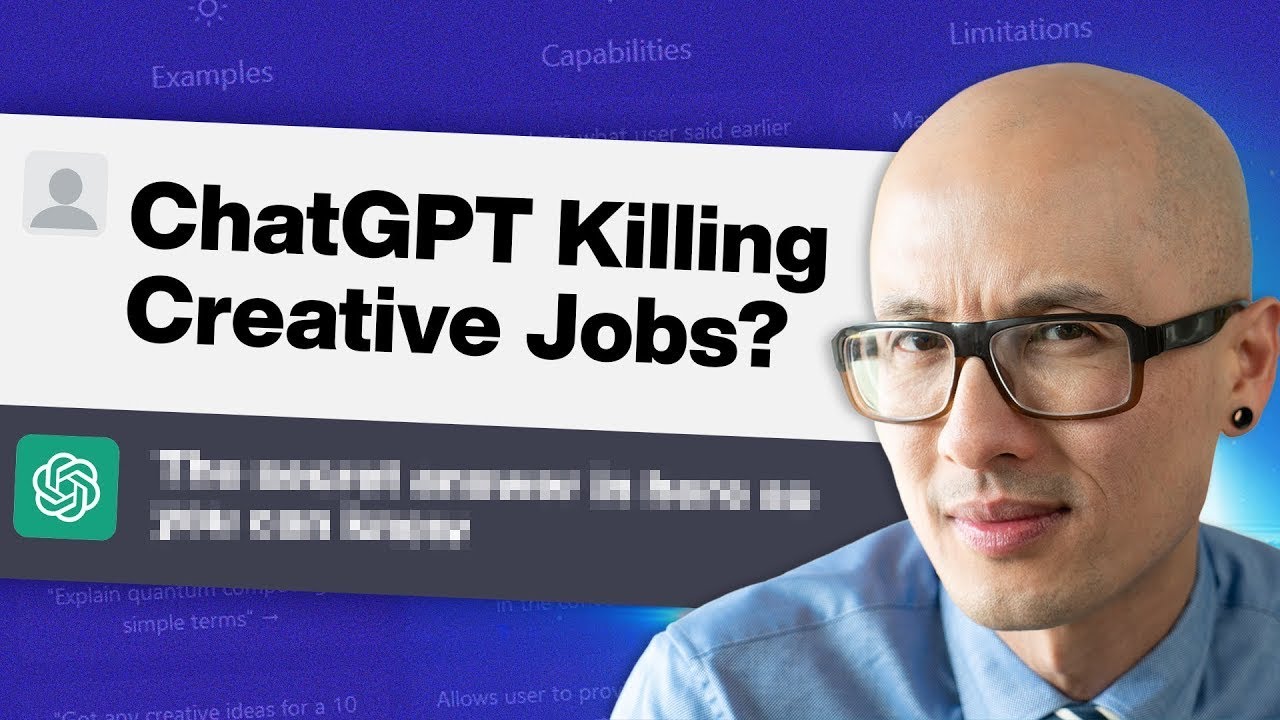
As you gaze into the horizon of your creative future, possibly clouded by concerns over the impending influence of AI, consider with us the unfolding landscape. In “Will AI End Creative Professions?”, a video presentation by The Futur, soapbox expert, Chris Do, shatters pre-emptive assumptions about AI’s potential threat to the creative workforce. Do combines his personal experiences working with AI and robust insights as he argues for a future where AI and creatives thrive side by side.
Beginning at the ArtCenter College of Design’s event, Do masterfully shares his current AI adventure – constructing an artificial version of himself. Roundabout on his mission to teach a billion individuals how to earn from passion, Do foresees a more refined AI, enhancing the demand for individuals who understand the relationship between the machine, art history, logic, and art direction. With an honest breakdown of the challenges and potential solution AI brings to content creators striving for the right title or thumbnail, Do invites you on a friendly exploration of the intersection between AI and creativity.
Get it here – #1 Recommendation Secrets of Success
Understanding Artificial Intelligence (AI) and Creative Professions
Defining AI and its Capabilities
Artificial intelligence, or AI, is a field of computer science that aims to create machines that mimic human intelligence. It’s a broad term that encapsulates various technologies like machine learning, natural language processing, robotics, and more. AI has the capability to learn from data, make decisions, predict future outcomes, and even understand and respond in human-like ways. This technological marvel is rapidly finding its way into different sectors, transforming industries, and the creative arena isn’t an exception.
Exploring various creative professions
Creative professions cover a broad spectrum. It includes professions like graphic design, artistic creation, writing, photography, music composition, filmmaking, and more. These professions often require a high level of creativity, skilled craftsmanship, and human touch. However, with the advent of AI, these professions are being reshaped in significant ways.
Understanding the concept of creativity in humans and AI
Traditionally, creativity has been seen as an exclusively human attribute. It involves generating original ideas, making unexpected connections, and producing work that has both aesthetic and practical value. AI, on the other hand, currently operates based on algorithms and datasets it has been fed. It can analyze, learn from, and mimic patterns but struggles to independently create truly original content. However, as AI continues to evolve, it’s beginning to blur the lines between human and machine creativity.
The Advent of AI in Creative Professions
A brief history of AI in the creative industry
AI’s integration into the creative industry has been an unfolding journey. It started with basic applications like spell checkers and morphed into more complex uses like generating art, drafting content, composing music, and even scripting films. The 1950s saw the beginnings of AI, but its serious incursion into creative professions began only in the 21st century with the advent of sophisticated technology and more powerful computational abilities.
Specific examples of AI integration in creative professions
AI has permeated various creative professions in fascinating ways. In visual arts, AI algorithms have been used to generate unique pieces of art. In writing, AI has been utilized to auto-generate news articles, poetry, and even short stories. Designers use AI for creating engaging user interface and experiences. AI bots are being used to compose music and even screenplays in the entertainment industry.
Public reaction to AI in creative jobs
The public reaction to AI in creative professions has been mixed. While some laud the potential of AI to boost productivity and generate new forms of art, others express concerns about its impact on jobs and the authenticity of AI-generated creations. The novelty of AI-created works often piques public interest, but at the same time, the lack of human touch can lead to criticism.
This image is property of i.ytimg.com.
Shop now – #1 Recommendation Secrets of Success
Benefits of AI in Creative Professions
Increase in efficiency and productivity
One of the biggest benefits of AI in creative professions is the increase in efficiency and productivity. AI can automate repetitive tasks, saving professionals valuable time. The speed at which AI can produce work also boosts productivity and the capacity to manage larger volumes of work.
Automation of routine tasks
AI can take over routine, mundane tasks that often consume a significant chunk of a creative professional’s time. For writers, AI can be used for proofreading and editing. For artists and designers, AI can assist in creating initial drafts or templates to work from.
Improvements in quality and precision
AI systems are typically highly accurate and consistent, which leads to improvements in the quality and precision of work done. For instance, AI tools can create pixel-perfect designs and can provide grammatically correct and linguistically consistent writing.
AI in Art and Design
Impact of AI on art and design professions
The impact of AI on art and design professions has been profound. AI has been used to create new pieces of art, assist in designing innovative products, and even predict design trends. While it has increased efficiency, there’s an ongoing debate about the artistic value of AI-generated creations.
Exploring instances of AI-created artworks
AI-created artworks have been popping up in galleries and auction houses. An artwork created by the AI algorithm GAN (Generative Adversarial Network) was sold at Christie’s Auction House for almost half a million dollars, signaling a growing marketplace for AI art.
Discussion on the aesthetic value of AI-created art
While AI-created art can be technically impressive, there’s ongoing discussion about its aesthetic value. Does it convey the same emotional depth and context as human-created art? It’s a nuanced debate with varied perspectives. While some argue that art isn’t just about technical creation but about human emotion and expression, others welcome this new form of artistic expression.
AI and Creative Writing
AI’s role in writing and editing
AI’s role in writing has been expanding. Tools like grammar checkers, style editors, and even content generators are frequently utilized. AI can draft basic news articles, write social media posts, and even craft poetry. It’s also helping in editing by spotting grammatical errors, flagging inconsistencies, and suggesting language enhancements.
Examples of AI-written content
AI-written content is increasingly common. For example, AI has been used to write sports and finance news articles, where the writing relies heavily on analyzing and reporting data. OpenAI’s GPT-3 can generate coherent long-form content that mimics human-like writing.
Debate over the emotive aspect of AI writing
The emotive aspect of AI writing is a topic of active debate. Can AI truly replicate the nuance, tone, and emotion of human writing? AI can certainly mimic styles, but its ability to infuse truly original emotion or deep contextual understanding into its writings remains questionable.
AI in Music and Entertainment
Evaluation of AI-generated music and video content
AI-generated music and video content is growing both in quantity and complexity. AI can compose music across genres by learning from a vast database of melodies and rhythms. It’s also used in scripting and editing movies, creating CGI effects, and even predicting viewer preferences.
AI’s influence on the entertainment industry
From fine-tuning streaming recommendations to scripting blockbuster films, AI is reshaping the entertainment industry. Music platforms are using AI to generate personalized playlists, movie studios are utilizing AI for better box-office predictions, and television networks are leveraging AI to analyze viewer sentiment and behavior.
Public reception of AI music and film
The reception of AI in music and film has been mixed. Some appreciate the novel uses and the scope it opens for more personalized entertainment experience. However, there’s also apprehension regarding the potential loss of human creativity and authenticity in arts and entertainment.
Challenges and Critiques of AI in Creative Professions
Lack of originality and emotional depth in AI-generated content
A significant challenge and critique of AI in creative professions is the perceived lack of originality and emotional depth in AI-generated content. While AI can mimic and create content based on learned patterns, it’s debated whether it can truly replicate the spontaneous originality and emotional nuance that human artists infuse into their creations.
Concerns about job displacement among creative professionals
Another challenge is the concern about job displacement among creative professionals. As AI becomes more competent at tasks traditionally done by humans, the fear of job loss grows. However, others assert that AI will not replace but redefine roles, freeing up professionals to focus on more high-level creative tasks.
Ethical considerations in AI creative applications
There are also ethical considerations associated with AI’s creative applications. Who owns the rights to AI-generated work? Can AI-generated work infringe on copyright laws if it mimics human-created work too closely? These are complex issues that require careful thought and regulation.
Case Study: The Futur’s AI Experiment
The Futur’s rationale behind adopting AI
The Futur, led by Chris Do, decided to adopt AI as a tool to scale and streamline their operations. Recognizing the inevitability of advancement in AI technology, The Futur used AI to build a virtual entity of Chris Do to reach out and educate more people. They view AI not as competition but as a complement that amplifies their reach and productivity.
The creation of an artificial avatar of Chris Do by the Futur
Using existing AI tools, The Futur created an artificial avatar of Chris Do, with the objective of making his vast knowledge and expertise available to a wider audience. This avatar is designed to mimic Chris’s knowledge and manner of delivering information, aiming to act as a virtual mentor for aspiring creatives.
Review of the AI Suite of tools offered by the Futur for generating social media content
The Futur is utilizing AI to generate social media content, automating the process of creating titles and thumbnails for their videos. The AI suite of tools they created is saving them time and resources, allowing them to focus more on the content’s creative aspects.
Preparing for an AI Dominated Creative Industry
Skills and adaptation necessary for creative professionals for the AI future
As AI continues to evolve and integrate into the creative industry, professionals must adapt. A blend of human creativity with an understanding of AI technology will be crucial. Skills such as AI literacy, adaptability to new tools, and the agility to integrate AI into creative processes can help professionals continue to thrive.
Potential roles for humans in an AI-driven creative industry
In an AI-dominated creative industry, humans will likely retain pivotal roles. AI technology can handle repetitive, tedious tasks, allowing human professionals to focus on abstract conceptualization, sophisticated craftsmanship, and complex strategizing. Emotional intelligence, creativity, and critical thinking – inherent human traits – are likely to remain in high demand.
Discussion on the concept of co-creation with AI
Co-creation with AI is an emerging concept, viewing AI not as a replacement but a collaborator. This perspective emphasizes combining human intuition and creativity with AI’s precision and scalability. It opens exciting avenues for fresh design processes, new forms of storytelling, and innovative artistry.
Conclusion
Assessing the likelihood and implications of AI ending creative professions
While AI is transforming creative professions, it is unlikely to end them. Instead, it will likely redefine them, leading to an evolution of roles and processes. The mingling of human creativity with AI capabilities is likely to yield a more efficient and expansive creative landscape.
Envisioning the future landscape of the creative industry with AI
The future of the creative industry with AI is intriguing. We’re likely to witness a blend of human creativity and AI capabilities, opening up new arenas of exploration. It may bring about novel forms of art and more personalized, dynamic content in music, film, and design.
Final thoughts on the interaction between human creativity and AI technology
At the convergence of human creativity and AI technology lies an exciting creative frontier. It’s not about humans versus machines, but rather, humans with machines. As we navigate this evolving landscape, we must remember that technology is a tool that, when used wisely, can enhance our creative possibilities, not limit them.
Leave a Reply